Pages

Monday, June 1, 2015

INTERROGATING WORSHIP by Jill Kayser


Welcome the children


Nothing encourages us more in the Kids Friendly office than when a minister phones (as one did recently) to say that he/she has been thinking about how to more effectively welcome children in church. We can’t get out of the door fast enough to start a conversation.

Christian educators have long recognised that a key to children coming to faith is their opportunity to engage in the practices of faith. As worship is one of our main faith practices, the way we welcome and include children in worship is vitally important if we take seriously the call to disciple children.


Kids Friendly offers training workshops on this important topic (Help there’s a child in my church (http://kidsfriendly.org.nz/becoming-kids-friendly/kids-friendly-training/kids-friendly-training-workshops/) and has a quick survey (Children in worship questionnaire – email jill@kidsfriendly.org.nz if you’d like it,) to help churches identify gaps and opportunities. However, truly welcoming children in church often requires a culture change.


I love and highly recommend an article “Welcome the Children” I read recently in an Australian publication “Equip”. The minister writer Alison Sampson talks about faith as a “culture” that children absorb when worshiping in community. Her church decided that children needed to be alongside adult Christian practitioners as much as possible, building intergenerational relationships that can ignite their faith. To truly welcome children she suggests we need to “interrogate” our worship services. She adds: “We weren’t interested in dumbing things down. We were interested in finding ways to add movement and symbolic actions that would be interesting to children.”

Are you up for “interrogating” your worship service to make it more welcoming of children?

Thursday, May 7, 2015

The Art of Love by Kaila Pettigrove

What difference can art make? For many people art is a luxury, an extra, or even frivolous. What can practical benefit can artistic endeavours exact?

This question was considered and answered in an amazing way by a ten-year-old girl in Auckland. When her school held a mufti day to raise money for cyclone relief in Vanuatu, Harriet put her art skills to good use.

She created and sold mini-stationary sets with intricate detail, gorgeous colours and ingenious accents.

I had an opportunity to talk to Harriet about the experience and this is what she had to say:

Kids Friendly: What inspired you to make your stationary sets?

Harriet: Mrs. F, our science teacher, gave me a bunch of miniature matchboxes. At first, I wasn’t sure what to do with them. It was then that I realised that the mini pencils I had made for my pencil box fit in the matchboxes. Kate (another girl in my class) really liked the idea so I made one for her. Then we heard about the mufti day to raise money for Vanuatu and I started making sets to raise money.

KF: Which item was the most fun to make? (Why?) 
Harriet’s mini-stationary may not replace
 lost items, but her contribution has boosted
the efforts to rebuild after the disaster. 
H: The most fun to make were the pencils because I got to choose all the colours and patterns.

KF: Do you have a favourite item?
H: My favourite item is the rubber.

KF: How long did it take you to fill all your orders?
H: All together it took over nine hours, 45 minutes for each set I made.
KF: Did anything surprise you about the process? (Was it more/less work? Did your friends react like you thought they would?)
H: Yes, it took me longer than I thought it would. My friends reacted exactly as I had imagined. (They were excited and more orders came in when they saw the first set.)

KF: How much did you charge per set and how much money did you raise in the end?
H: I charged $2 per set and managed to raise $32. Altogether for the mufti day (from chores, sponsorship and my pencil sets) I raised $122.

KF: Do you know where the money will go?


H: All the money raised went to Vanuatu.

KF: What do you hope will be done with the money?
H: I hope that the money will be used to help rebuild the houses that were destroyed in the recent cyclone.

KF: The Kids Friendly art and writing competition always carries the theme, "Love Reaches Out." This year, we are focusing on "Love is..." How would you finish the sentence, "Love is…"?
H: In this perspective, Love is being kind through your actions.
“Kind actions do not cost much yet they accomplish much”- Blaise Pascal

KF: Why do you think it's important for people who want to live a Christian life to think about these things?
H: To lead a Christian life is to follow [Jesus’s] example and lead a better life while helping others to do this too.

Harriet’s project is a perfect example of someone using their gifts and talents to reach out to others in love. Harriet spent hours and hours using her skills, brought joy to her classmates, and helped people she didn't even know.

When we recognize our talents as gifts from God and use them as such, it is amazing what we can do.

During our annual “Love Reaches Out” art and writing competition, we challenge children to consider how they might reach out in love to those around them. They express their response through artistic or written means. For more information on entering the “Love Reaches Out” competition, visit our website: http://kidsfriendly.org.nz/love-reaches-out-love-is/


Kaila Pettigrove is a part-time
Kids Friendly Coach in Auckland. 

Her latest creative endeavour
 was teaching her son to snorkel!

Wednesday, April 8, 2015

Do you have a good children’s ministry? by Jill Kayser

A minister of a church with a once “thriving” children’s ministry shared with me today how they now only have about five children attending church on a Sunday. “We need help!” he exclaimed. It’s not an uncommon story and one that certainly challenges me in my role as the Kids Friendly advisor and coach as I seek to be “helpful” to churches around the country.

The reality is that children’s ministry, like any ministry, is not a constant. Too often we think all we need to do is offer lots of attractive programmes and all will be well. And to be fair that has seemed to work (on the surface anyway) in the past. But effective ministry with children requires so much more than programmes and unlike programmes, its success cannot be measured in tangible ways.

While still reflecting on this church’s situation I came across this blog “Good Children’s Ministry”. It seemed like a message straight from God. The minister/author shares his “humble learnings on the joys and challenges of forming faith in children.”

He suggests that rather than judging our ministry with children as good or bad, we should view ministry to and with children through a different set of lenses.

· Alternative Lens #1: Children’s ministry does not consist of only the programmes a congregation offers for children, but is the sum of all its collective interactions with children in the name of Jesus. When an adult or a young person extends welcome, friendship and care to children before, after or during Sunday worship, that is children’s ministry. When a child experiences a non-parent adult as a living model of faith in a cross-generational small group, that is children’s ministry. When a pastor extends a personal blessing to each and every child at the Communion table, that is children’s ministry.

· Alternative Lens #2: The most important ministry to children a congregation can engage in is ministry to their parents. Parents are the most significant “faith shapers” in the lives of children. When parents are equipped and supported to share their faith with their children and the parents are themselves growing in faith, then a great deal of children’s ministry will be taking place in “non- gathered” ways. Even if a congregation had no Sunday children’s programme, but was investing in supporting faith-at-home, it would still have a very significant children’s ministry.

· Alternative Lens #3: Children’s ministry is when persons of all ages and stages are nurtured as disciples of Jesus Christ. Healthy, vibrant, spiritually mature communities of faith reproduce themselves as people of all ages “do” faith together. Intentional, strategic efforts to develop the faith lives of adults are an important building block for children’s ministry, particularly where these encourage adults to take more seriously their role as spiritual role models, mentors and elders for children.


· Alternative Lens #4: Authentic and respectful inclusion of children into the 
worship life of the congregation is an extremely significant component of a congregation’s ministry to them and with them. Because faith is more “caught than taught” and the gathered worship of the congregation is its primary faith practice, it is vital that children are encouraged, assisted and enabled to take their place alongside persons of other generations as fellow worshipers. Children, youth and adults alike are formed as worshipers by worshiping. Excluding children from the primary gathered activity of the church, or constructing worship that does not acknowledge their presence and their capacities to give and receive, diminishes both them and the wider faith community. While children may not fully understand everything that is said and done in worship services (do adults?), they take in and apply much more than adults realise. They can also contribute in more ways than adults often realise and appreciate. It is my personal observation that sustained involvement and inclusion of children in worship into their youth produces greater maturity of faith than exclusion of children into separate “children’s church” activities.

· Alternative Lens #5: Cross-generational activities enable ministry to children by creating space for relationships to flourish across generations. The Sticky Faith research emphasises how important it is for children of the church to know and be known by five or more non-parent Christian adults who are invested in their growth and wellbeing. Cross-age fellowship gatherings, cross-generational learning events and cross-generational service and mission activities can be fertile soil for the Holy Spirit to work in the “space between” people of different ages and stages. Mentoring, buddy or adoptive grandparenting initiatives can also be very effective means of tending the faith journeys of children.

“So, does my congregation have a “good” children’s ministry?” asks the writer. “It’s a matter of perception. It certainly is by no means all we might hope it to be. But perhaps what we are aiming for is somewhat different too. Our goal, in my view, is to not be merely a church with a children’s ministry, but to be a church of children’s ministry.”

Amen. Amen. Amen! Thanks to this unnamed Lutheran Pastor from Queensland, Australia and to the Forming Faith blog.

Monday, March 2, 2015

Get creative with your prayer by Jill Kayser

My reading some years ago of the inspiring book “Red Moon Rising” by Greig and Roberts of the “24/7 Prayer Movement” affirmed my belief that prayer can take many forms.  It challenged and encouraged me to think more intentionally and creatively about how I pray with children.
So often when I ask children’s leaders whether they include prayer in their time with children, I discover it is either omitted or the adults pray while the children close their eyes.
Confuscious’ wisdom:  “Tell them and they’ll forget, demonstrate and they’ll remember, involve them and they’ll understand” is worth heeding when praying with children.  Prayer is now always central to any lesson I plan with children and takes all forms: rowdy, interactive, active, quiet, contemplative, creative and more.
Our Christian tradition is rich in written and spoken prayer, but this can sometimes involve too much head and too little heart. Physical actions can really capture the essence of a prayer.
 In her blog “Tactile Prayer – using your body and senses to connect with God”, Lisa Brown suggests that lighting candles, holding prayer beads, or stones, help focus the mind and give substance to our prayers.
Praying through art (see Sybil Macbeth's Praying in Color or Roger Hutchinson's The Painting Table,) offer the artist in all of us a way to put the range of our feelings to paper,” says Lisa.
Kaila Pettigrove, children’s ministry leader at Somervell Presbyterian is involved in creating an all-age prayer room during Lent. “The room will include  multisensory prayer stations, quotes on the wall, candles to light, Post it Notes for intercessory prayer and devotional material (of all reading levels) available.  It’s hoped that eventually we can develop a “prayer gym” with resources and exercises to build up one’s prayer stamina.  The room will be open whenever the church office is open for people to come and spend time in conversation with God,” says Kaila.  
Lisa Brown shares a multi-age activity for creating prayer stones. “We discussed types of prayer: thanksgiving, forgiveness, and petitions. We considered who we might pray for - ourselves, those we love, and the broader world. Then we created our own prayer stones, drawing images on small craft store pebbles. I gave each child a little drawstring bag in which to store their stones.”
Years ago I created a prayer wheel for the kids of our church.  They suggested what types of prayer to list around the wheel and took great delight in spinning the wheel and then responding with the appropriate prayer.
“Tactile, artistic prayers can create meaningful community prayer and focal points. I was particularly inspired by one church's prayers for peace manifested in hundreds of origami cranes, each one lovingly created and then hung in a cascading mobile. At a holiday programme, we created a giant prayer cross, cut from a 7 foot sheet of corrugated cardboard and covered with children's hand prints, each one a prayer,” says Lisa.
Blake with his special prayer blanket
And tactile and creative prayers aren’t only for children.  Adults also respond enthusiastically to the many physical forms of prayer. Members of Waikanae Presbyterian pray as they knit to create beautiful prayer shawls for those in need.  And women of the Karori community of churches create prayer quilts.  My son Blake was a recipient of one of these beautiful creations when he underwent brain surgery.  Each member of the congregation tied Amish knots in strings hanging from the quilt as they prayed for his recovery.
For more ideas on tactile prayer for all God’s children see stories of Lenten prayer stations and prayer journeys on our Kids Friendly website, download our “Kids Friendly Prayer” resource, explore the wonderful world of Pinterest and borrow these books from the Kids Friendly library:  “New ideas for creative prayer” and “Multi-sensory prayer”.
Jill Kayser is the Kids Friendly Coach for the Presbyterian Church of Aotearoa New Zealand


Tuesday, February 10, 2015

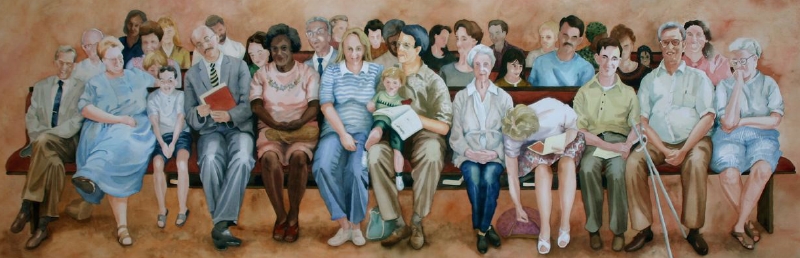
The Glue in an All-Age Pew


"We tend to think of the most sacred places in our sanctuaries as behind the pulpit, table and font or even beneath the cross, but the pew is just as holy.  The space between us and among us in the pew is sacred as well."  Rebecca Kirkpatrick.

I have a confession to make: When I first heard Jill Kayser suggest that churches scrap their creches and bring beanbags and mats into the church and sit with their bubs during service I was mortified!  (GASP!)
The Noise!  The Distraction!  How could anyone listen?

I have changed my mind. I still believe that some people will feel more comfortable in a creche or nursery. I had some wonderful bonding and learning moments with my children in the church nursery. But I do think there is space for our small people to be in the service with us.  There is something about worshipping with all ages that brings a community together in a way that is entirely different than a potluck lunch.  I wonder if maybe there is some kind of superglue that is created as we bump along together through our hymns, songs, readings and prayers.  

Rebecca Kirkpatrick sums it all up beautifully in her most recent blog "Attachment Worshiping: sharing the pew with one another."

"It has been two years now since I left my work in congregational ministry— which means that for the past two years I have been able to consistently worship with my family instead of sitting in the “pastor’s” seat in the sanctuary. We have gotten into a particular habit lately, where my son sits in between my husband and I in the historic and weathered pews of our small congregation.
Frequently during worship I will feel my son grab my hand and rap my arm around his shoulders. He is still about a head shorter than me, so often during the standing portions of the service he will slip in front of me with his back resting on my front so we can share a bulletin. Regularly he needs a simple reminder in the form of a firm squeeze on his knee to help him be still so as to not distract the kind people who worship behind us every week.
I have not gotten too caught up in the attachment parenting pros and cons as a variety of people debate the benefits of baby-wearing, bed-sharing and other attachment practices.

But what I am is a huge proponent of attachment worshipingwith our children: doing what we can to make them feel safe and comfortable in that space; reaching out to them to make worship not just about a singular interaction between the individual and God, but something that we do as a community and as a family that connects us with one another; acknowledging that learning to be still and attentive in worship can be hard for some children (especially mine) and connecting with them physically in that space recognizes the ways their bodies yearn to move and wiggle.

We tend to think of the most sacred places in our sanctuaries as behind the pulpit, table and font or even beneath the cross, but the pew is just as holy. The space between us and among us in the pew is sacred as well.
It is inevitable that we form connections and attachments with those next to whom we sit in worship.  Read More...

Wednesday, November 5, 2014

Taking (some of) Christmas Back by Kaila Pettigrove

What is your reaction when you see Christmas decorations in the supermarket before October has finished? For some people, Christmas decorations/trees/stockings are what make the holiday season “feel like Christmas.” Merchandisers have definitely picked up on and exploited this. The sooner they get us into the Christmas spirit, the sooner we are ready to do our Christmas shopping! How do we keep our excitement and anticipation, without getting hijacked by the materialistic storm?

I am an unabashed enthusiast when it comes to celebrating. Silly hats, candles that won’t blow out and paper streamers are still not beneath me at the ripe age of 43. So when I married a man who runs the other way when he sees Christmas decorations and hides when the Christmas tree appears; we needed to do some compromising. When our children came along, there were Peace Summits held into the wee hours of the morning.

Over the years, I have gleaned from many sources ways to take back my Christmas Season and make time to reflect. Does that mean that on Christmas eve I am dressed elegantly, sipping sparkling grape juice and reading the Christmas story in Latin by candlelight? Hardly! I still experience all the stress of prizegivings, Christmas Pageants and end of year parties. However, our family has decided on two traditions that are non-negotiable and we make room for them. I’ve outlined these below in case you might like to give them a test drive this year.
The Progressive Nativity

Sometime before the beginning of December (hopefully) we gather together to unpack our nativity scene. I inherited this gem from my grandmother who spent years collecting the pieces. If you don’t have a set yet, perhaps your tradition could be to make/buy new pieces each year as presents for one another. (Kids Friendly has a great pattern for a knitted nativity for those who are handy with the needles!) Once all the pieces have been unwrapped and remarked over (Oh look, the little shepherd!!!) they are placed at one end of the piano top. The stable is placed at the other end. On the first day of advent, the Angel Gabriel is placed (by my son and youngest child, Gabriel) on his hook at the top of the stable roof.

My daughters then choose an animal or person to move closer to the manger. (Usually it is Mary and Joseph, but this varies from year to year as our animal-loving instincts sometimes win out and the sheep get first dibs.) Each day (or as often as we remember to do it) we take turns placing one or more creatures closer to the stable. On Christmas eve, Baby Jesus is placed in the manger with great excitement and panache. WARNING: For several years in a row I have had to HIDE Baby Jesus to keep excited people from plopping him into the manger (when no one is looking) before the Big Day.
The Modular Advent Calendar

Tiring of the “MAY WE HAVE OUR CHOCOLATE NOW?” routine that overtook our advent reflections, I finally prevailed upon a generous grandparent to bestow upon us a re-usable advent calendar. It is made of sturdy pressed cardboard and is shaped like a Victorian House. There are several numbered doors and windows which open into little boxes of varying shapes and sizes. If you have a woodworker in your family, this could be an excellent project! Sometime before advent I fill each box with one of the following: a scripture verse pertaining to the prophesy or Christmas Story, a small treat, one of our nativity characters, or a “challenge” for a family activity (e.g. tell each person in the family your favourite thing about them). Each day the children alternate who opens the Advent door to find the surprise. This is usually done just before dinner so we can talk about what was found and how it relates to Christmas. NOTE: This is a lovely ideal that actually ended up quite stressful in its execution. This year, my daughters (ages 10 and 12) have offered to help me prepare some of the boxes. This means one third of the boxes won’t be a surprise for them, but they are excited about coming up with new things to put in them and surprise their family. I am excited about only needing to come up with ideas for eight boxes instead of 24!!! Now, each day will be very different and each year will be too.

The best part: My daughters are taking ownership of a tradition and a faith that once only surrounded them is now a part of them. In the flurry and rush of the pre-Christmas season, they know there is a place of calm where they can celebrate and thank God for His precious Gift in their hearts. My prayer is that their brother will one day join them as he grows in his faith…and their father will no longer complain about the Christmas tree.


Kaila Pettigrove is a part-time Kids Friendly Coach in Auckland. She is married to the effervescent Glen and together they have three children. 

Wednesday, July 30, 2014

Noise by Mo Morgan

This morning my 2 ½ year old son popped into my bed at around 5:30am. He chattered away to me for an hour or so before convincing his Dad to go downstairs and get breakfast on. I dragged myself downstairs a short time after. A shower and coffee usually perks me up and gets me going. On a normal day, the next hour or so goes pretty quickly. There’s lunches to make, chores to be done, a piano to be practiced, a husband to kiss good bye, homework bags to find, uniforms to pop in the dryer because you forgot to bring the washing in last night, bags to pack, 3 kids to strap in to car seats, kids to deposit at school and kindy... then I try and put that to one side to focus on what I might be doing that morning.

That’s the start of my day. It’s always busy often noisy. Sometimes the noise is happy and that’s ok. On a good day, my children embody the passage ‘make a joyful noise all you people.’ Sometimes, not so much. There are days when the noise my children make is the sort that wears you down. Sometimes I wish they would be still and know that I (I mean, GOD) is God.

And my children are just one of the noise makers in my life. Everywhere we go, there are noises filling up the airspace, images looking to catch our attention. Some of it we have little control over. Whether we like it or not, there are companies and organisations everywhere, trying to catch our attention. A recent study demonstrated that on average we see 600 advertising images per day. We notice probably 75 of them. Our brains can’t truly notice or process as many at 600 messages a day, so we instinctively skim the surface, browse, graze, take in a glimpse. Most things, even if they relate to values we find important, will evaporate into the busyness of our day. Marketers know this. It’s common knowledge that people today are dealing with absolute sensory overload. So these days marketers go to extreme measures to attract our attention. They know that they only have our attention for a second, if that. If they want us to remember their product, they need our emotional engagement to buy or at least investigate the advertised product or service.

There are other forms of noise and distraction we do have more choice over. These days we are living in a world where mothers take pride in multi-tasking, busy-ness is a virtue, teenagers talk to each other across the room on their cell phones and everyone’s willing to be interrupted by a Facebook update. Our lives can easily become distracted and disconnected, and how we handle the noise and distraction around us is changing our culture.

People of the new generation are busy. Busier than ever before. As the church tries to connect with people in the community, should it join the competition for people’s attention? Tempting. But I don’t think so. One of the unique things the church has to offer people who are overwhelmed by busyness and disconnectedness and distraction, is an alternative. Opportunities and spaces to ‘be’ as well as ‘do’. Moments which allow people to ‘let go’ and experience the peace that can be found from just ‘being’. Time to dig a bit deeper, reflect on The Story, think about what’s meaningful and important – not just to us personally, but to the world around us.

It is a counter-cultural idea but that’s what our leader specialises in. In the gospels, Jesus consistently advocates for being a counter-cultural example in the world. ‘Don’t copy the behavior and customs of this world, but be a new and different person with a fresh newness in all you do and think.’

But as well as offering an alternative to the distracted disconnected lifestyle, the church has more to offer people in our communities. The church is called to do more than just connect or engage. We can leave that to advertising agencies. What the church has to offer is the same thing it has always had to offer: Love. I am convinced that God’s love is infinitely more satisfying than anything money can buy on the internet. The story we live by is all about love. And I believe we are not only called to offer it, but also called to generate it in the community. That is our challenge, that is our call.

What does love look like? Well the answer to that’s going to look different depending on your context, depending on the people in your community. I belong to St James in Whanganui East. Something special has been happening at St James recently. New people have started coming to church. I don’t just mean people defecting from other churches, I mean people who haven’t been to church before.

Recently we had the wonderful, wise, Jill Kayser visit us to start us on the journey to become Kid Friendly. Jill reminded us that if we wish to offer anything to people in our communities, then children are a good starting point, because of all the generations, they are the ones with the least inhibitions, the least sceptism. We spent the evening talking about the why and how of ministering to children in our church and wider community, and various issues and challenges were raised, including the issue of children making too much noise during the services.

One of the greatest gifts Jill gave us was reminding us what love looks like to children and their parents. It’s been so long since there’s been a decent child population at St James, people have forgotten what love looks like for the children and parents in our midst. We need to rethink and relearn what love looks like in our church and how to generate it in the community. What occurred to me as I listened to the discussion was that noise is really a red herring issue. If we get on with the core business of loving people, not attracting people, not converting people, not keeping people entertained or busy, REALLY loving people, issues like noise take care of themselves.

Jesus knew this of course, that’s why he made his greatest commandment all about Love. As the great cartoonist Michael Leunig puts it: Love one another and you will be happy. It is as complicated and simple as that. There is no other way. Amen.

Mo Morgan is married to Kirk and lives in Wanganui with their three beautiful children.  Mo is a leader at St James Presbyterian Church.  She and her team lead intergenerational worship twice a month and a variety of ministries serving their community of children and families.  Mo will begin her training to become an ordained minister in 2015.  This blog is an extract from a sermon shared at a worship service led by Mo at the Central Presbytery's Gathering in Palmerston North in April 2014.